Saturday, May 7, 2011

Walking the Talk: How Many People Would Eat Meat if They Had to Kill it Themselves?

0 comments

Today Mr. Man and I headed out to Wolfscratch to help process chickens.  “Why would we do this?” you might ask.  Well, we’ve been on a path the last couple of years.  Eating things in season—you can’t imagine how sick of carrots and root vegetables you can get during the winter months—that are locally (or at least regionally) grown and organic, and only buying/eating pasture-raised meat (this includes at restaurants, which means I order a lot of seafood when we go out unless we are at a farm-to-table restaurant).  So, helping to process chickens was an opportunity and a test to our commitment to getting closer to our food that couldn’t be passed up.

Six-week old Cornish-Cross chickens
Wolfscratch recently acquired 150 Cornish-cross chickens (these are the same pasture-raised chickens you buy at supermarkets or organic food stores) and they needed to be “harvested” within a couple weeks; personally, I hate the term harvest when used in reference to killing animals.  These birds are cross-bred to have the larger breast of one chicken and larger legs of another.  They grow every fast; at 5 weeks—when they are ready to process—they are huge and walk with the wide-stanced lumber of a toddler.  When I first saw them they were lumbering around the pasture looking for bugs, and I felt an overwhelming sense of sadness knowing their fate.  But, I was committed.  If I’m going to eat meat, I should be willing to kill it.

Please don’t think this means I looked forward to it, I didn’t.  And I didn’t enjoy it, I can’t imagine anyone would.

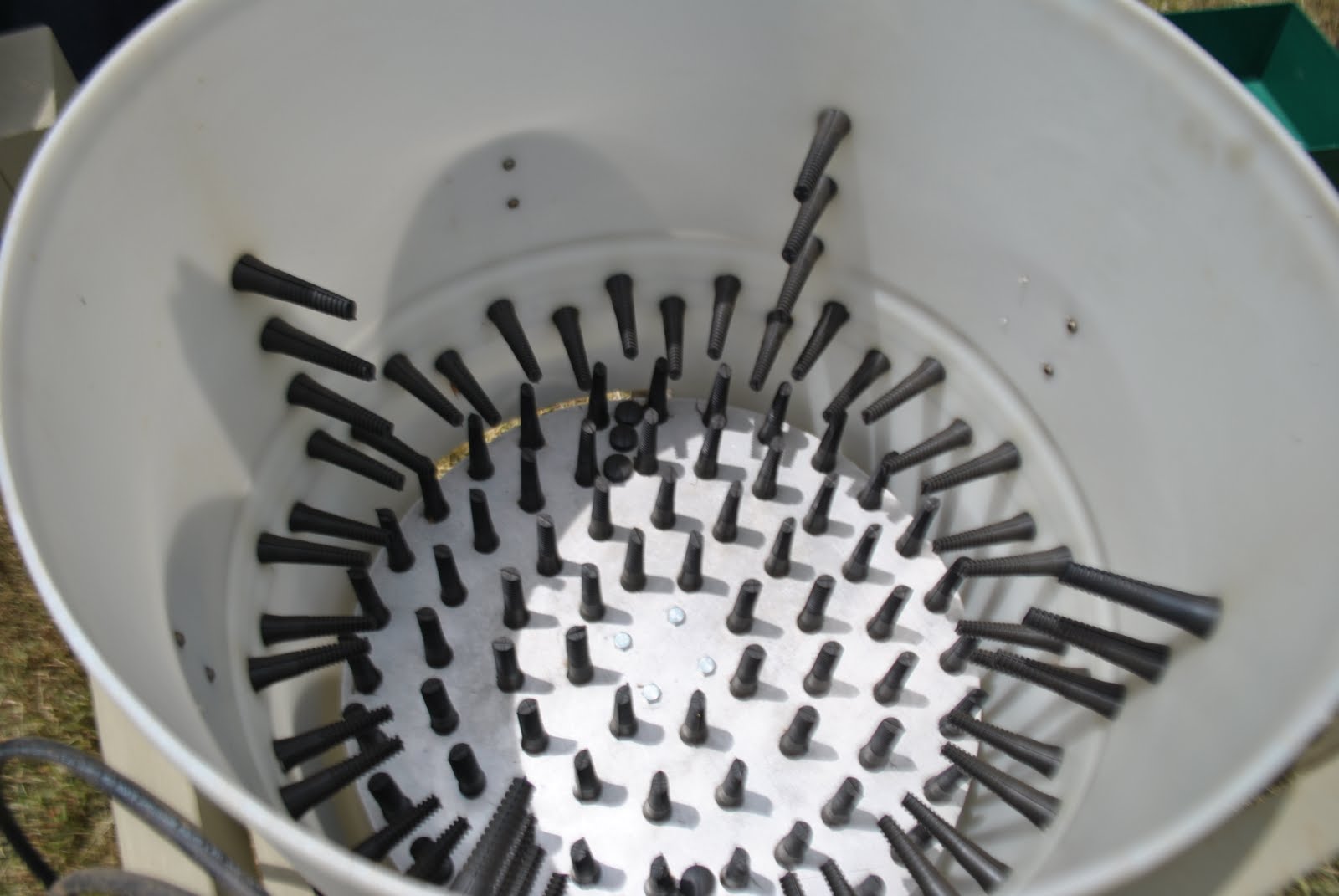
After we set up our processing station with cones for holding the chickens, hot water bath, plucker (handmade by Michael of Blackwell Farm) and stainless steel tables for evisceration, we all looked each other in the eye, the unspoken question “Are we sure we want to do this?” hanging in the air, and took a deep breath before turning our attention to the lesson of killing chickens in the most humane way possible.  I watched intently as I didn’t want to mess up when it came my turn to take the knife.  I must confess, once the deed was done, tears welled up in my eyes and I had to walk away to collect myself before rejoining the others to continue the lesson.  Needing to get it out of the way, I volunteered to kill the next set of birds.  I whispered my thanks and killed them quickly and cleanly.

Handmade Plucker

We managed to get about 30 chickens processed in the next couple of hours, after which time we had had enough of killing and cleaning.  On the way home I again felt a deep sadness and thought for the first time seriously about the benefits of vegetarianism.  I believe everyone who eats meat should have to kill their own at least once.  If we can’t do it, perhaps we shouldn’t eat meat.  We have become too removed from our food, so much so that we shut our eyes and plug our ears to the horrors of industrial food production or CAFOs (Concentrated Animal Feed Operations).  I prefer to know where my food comes from, what it eats, and how it’s raised.

Saturday, April 30, 2011

An Early Morning Trip to the Zoo

0 comments

Today is one of my favorite days of spring, the Zoo Atlanta Plant Sale. Every spring for the past four or five years, Mr. Man and I get up and out the door to be there at 8am. The plants are healthy, varied, and inexpensive.

We are working on some of the beds in the backyard and quickly filled up our wagon and several trays with Foxgloves, Hostas, Foamflowers, Peruvian lilies, and Coral Bells. We were home by 8:30am and quickly plotted out were each would go, and after breakfast I began digging.

Before
After: Foxgloves, Tiramisu Coral Bells, Caramel
Coral Bells & 'Dark Star' Foamflower

Before
After: Hosta 'June', Tiramisu Coral Bells, Caramel
Coral Bells & 'Dark Star' Foamflower


Sunday, April 24, 2011

Making Room for Tomatoes

0 comments

The front yard has begun its metamorphosis. Ligustrum and holly bushes have been removed and loropetalums transplanted; I love the purple color of this low maintenance shrub. I allow mine to grow freely as I find their natural growth pattern a better fit to the casual feel of my front garden, but it can pruned into a hedge for a more formal look.


Cypress, knockout roses, smoke tree & rosemary
The rosemary benefited from a much needed pruning, although it is hard to tell it’s still so big. The sky pencil holly—the only one of three to survive—has been moved to a pot on the steps and the knock-out roses have been transplanted to the side of the porch. I hated doing such a hard pruning as they were in beautiful bloom, but it’s necessary for a healthy comeback. They cypresses are gone as well and now all’s that’s left to do is amend the soil and plant tomatoes!

Transplanted knock-out roses
New space for tomatoes
Former location of Loropetalums
Truthfully, there are a couple of other things to move but only for aesthetics and balance, and that can wait until later this summer. We also planted lavender along the front walk and creeping time in the front beds.  If I’m successful in having a tree removed, there will be some hosta, ferns, and coral bells that will want to make their way to the back garden as well; making room for cucumber trellises.

Jamie and Michael fromt he co-op drove to Tennessee a couple weeks ago to a Mennonite farm to buy transplants and picked up a few heirloom variety tomato plants for me. I picked up a few more at Farmer D’s yesterday—Cherokee Purples and Brandy Wines—along with 10 bags for beautifully composted garden soil. All this rearranging gives me room for 10 tomato plants among the roses, herbs and flowers in the front yard. I can't wait.

The garden is a long way from where it was 13 years ago when we moved into this house…guess I’ll never really be done with it.

Friday, April 22, 2011

Where Did America's Money Go?

1 comments

Where did America’s money go? Let me just state right off the bat that it wasn’t to healthcare, education, children’s health insurance, Planned Parenthood, or any of the other so-called “entitlement” programs the GOP is raping and pillaging as part of their “stop spending” agenda.  America’s money has disappeared into the pockets of major corporations in the form of tax breaks, rebates and refunds.

Top Ten Worst Tax Evaders
from Senator Bernie Sanders
1) Exxon Mobil made $19 billion in profits in 2009. Exxon not only paid no federal income taxes, it actually received a $156 million rebate from the IRS, according to its SEC filings. (Source: Exxon Mobil's 2009 shareholder report filed with the SEC here.)

2) Bank of America received a $1.9 billion tax refund from the IRS last year, although it made $4.4 billion in profits and received a bailout from the Federal Reserve and the Treasury Department of nearly $1 trillion. (Source: Forbes.com here, ProPublica here and Treasury here.)

3) Over the past five years, while General Electric made $26 billion in profits in the United States, it received a $4.1 billion refund from the IRS. (Source: Citizens for Tax Justice here and The New York Times here. Note: despite rumors to the contrary, the Times has stood by its story.)

4) Chevron received a $19 million refund from the IRS last year after it made $10 billion in profits in 2009. (Source: See 2009 Chevron annual report here. Note 15 on page FS-46 of this report shows a U.S. federal income tax liability of $128 million, but that it was able to defer $147 million for a U.S. federal income tax liability of $-19 million)

5) Boeing, which received a $30 billion contract from the Pentagon to build 179 airborne tankers, got a $124 million refund from the IRS last year. . (Source: Paul Buchheit, professor, DePaul University, here and Citizens for Tax Justice here.)

6) Valero Energy, the 25th largest company in America with $68 billion in sales last year received a $157 million tax refund check from the IRS and, over the past three years, it received a $134 million tax break from the oil and gas manufacturing tax deduction. (Source: the company's 2009 annual report, pg. 112, here.)

7) Goldman Sachs in 2008 only paid 1.1 percent of its income in taxes even though it earned a profit of $2.3 billion and received an almost $800 billion from the Federal Reserve and U.S. Treasury Department. (Source: Bloomberg News here, ProPublica here, Treasury Department here.)

8) Citigroup last year made more than $4 billion in profits but paid no federal income taxes. It received a $2.5 trillion bailout from the Federal Reserve and U.S. Treasury. (Source: Paul Buchheit, professor, DePaul University, here, ProPublica here, Treasury Department here.)

9) ConocoPhillips, the fifth largest oil company in the United States, made $16 billion in profits from 2006 through 2009, but received $451 million in tax breaks through the oil and gas manufacturing deduction. (Sources: Profits can be found here. The deduction can be found on the company's 2010 SEC 10-K report to shareholders on 2009 finances, pg. 127, here)

10) Over the past five years, Carnival Cruise Lines made more than $11 billion in profits, but its federal income tax rate during those years was just 1.1 percent. (Source: The New York Times here)

Now let’s imagine these tax evaders actually paid the current corporate tax rates, which according to Wikipedia are:

Taxable Income ($)
Tax Rate
0 to 50,00015%
50,000 to 75,00015%
75,000 to 100,000$13,750 + 34% Of the amount over 75,000
100,000 to 335,000$22,250 + 39% Of the amount over 100,000
335,000 to 10,000,000$113,900 + 34% Of the amount over 335,000
10,000,000 to 15,000,000$3,400,000 + 35% Of the amount over 10,000,000
15,000,000 to 18,333,333$5,150,000 + 38% Of the amount over 15,000,000
18,333,333 and up35%
           This rate structure produces a flat 34% tax rate on incomes from $335,000 to $10,000,000, gradually
           
increasing to a flat rate of 35% on incomes above $18,333,333.
 
And, add back all those undeserved rebates and refunds…

Corporation
Taxable Income/Profit ($)
Tax ($)
Rebate/Refund ($)
Total ($)
Exxon Mobil19,000,000,0006,650,000,000156,000,0006,806,000,000
Bank of America4,400,000,0001,540,000,0001,900,000,0003,440,000,000
General Electric26,000,000,0009,100,000,0004,100,000,00013,200,000,000
Chevron10,000,000,0003,500,000,00010,000,0003,510,000,000
Boeing*750,000,000262,500,000124,000,000 386,500,000
Valero Energy*1,700,000,000595,000,000157,000,000 + 134,000,000886,000,000
Goldman Sachs2,300,000,000 805,000,000805,000,000
Citigroup4,000,000,000 1,400,000,0001,400,000,000
CononcoPhillips16,000,000,000 5,600,000,000451,000,0006,051,000,000
Carnival Cruise Lines11,000,000,000 6,650,000,0003,850,000,000
Total40,334,500,000
*this is a little hard because I’m not sure what the taxable income would be on Boeing’s $30 Billion and Valero’s $68 Billion, so I’m calculating 25% of each of those numbers as profit.

That’s over 40 Billion dollars!! $40 Billion!!

This figure doesn’t even include repayment on the $800 Billion the Federal Reserve and U.S. Treasury gave to Goldman Sachs, the $2.5 Trillion they gave to Citigroup or the nearly $1 Trillion they gave to Bank of America. If these companies paid just 1% interest on those loans we’d be adding another $8 Billion, $25 Billion and $1 Billion respectively, bringing the total to more than $74 Billion toward paying down our national debt. So, why we are cutting much needed funding from the elderly and the poor while these corporations and their shareholders make money hand over fist and don’t pay their fair share?